Key Takeaways: Archer Aviation v. Vertical Aerospace highlights the significance of intellectual property in the eVTOL space. The outcome of the litigation could inform the scope of patent protection for next-generation aircraft and the technologies that enable them.
On February 23, 2026, U.S.-based Archer Aviation Inc. (“Archer”) sued U.K.-based Vertical Aerospace Ltd. and Vertical Aerospace Group Ltd. (collectively, “Vertical Aerospace”) for patent infringement in the Eastern District of Texas, alleging that Vertical Aerospace’s newly unveiled “Valo” electric vertical takeoff and landing (eVTOL) aircraft infringes the appearance and certain flight-control technology of Archer’s “Midnight” eVTOL. Archer initially asserted two design patents and one utility patent.
On June 12, 2026, Archer amended its complaint, asserting two additional utility patents. As of its amended complaint, Archer asserts five total patents (the “Asserted Archer Patents”):
- U.S. Design Patent No. D1,062,878 (the “D878 Patent”), claiming the overall visual impression of the Midnight V-tail and fuselage design;
- U.S. Design Patent No. D1,067,164 (the “D164 Patent”), claiming the overall visual impression of the Midnight V-tail, fuselage, and wing design;
- U.S. Patent No. 11,945,597, titled “Systems and Methods for Control Allocation for Electric Vertical Take-off and Landing Aircraft”;
- U.S. Patent No. 12,649,572, titled “Vertical Take-Off and Landing Aircraft”; and
- U.S. Patent No. 12,522,352, titled “Systems and Methods for Power Distribution in Electric Aircraft.”
Archer also included a side-by-side comparison of the D878 Patent and the D164 Patent against Vertical Aerospace’s asserted product, as below.
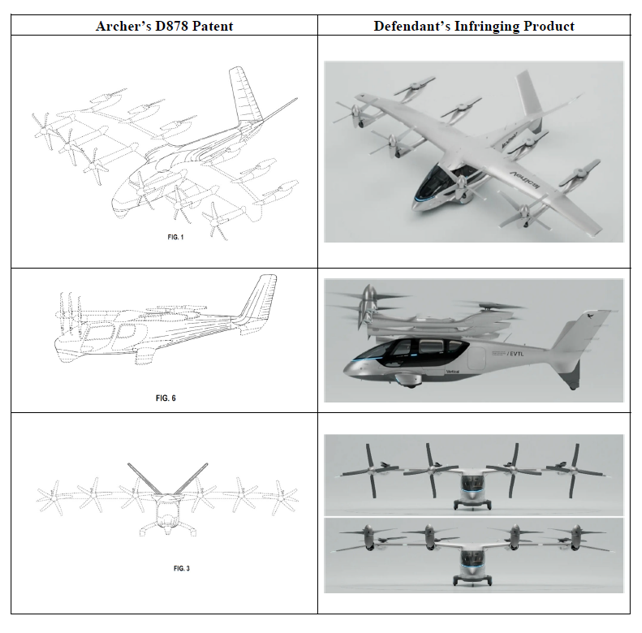
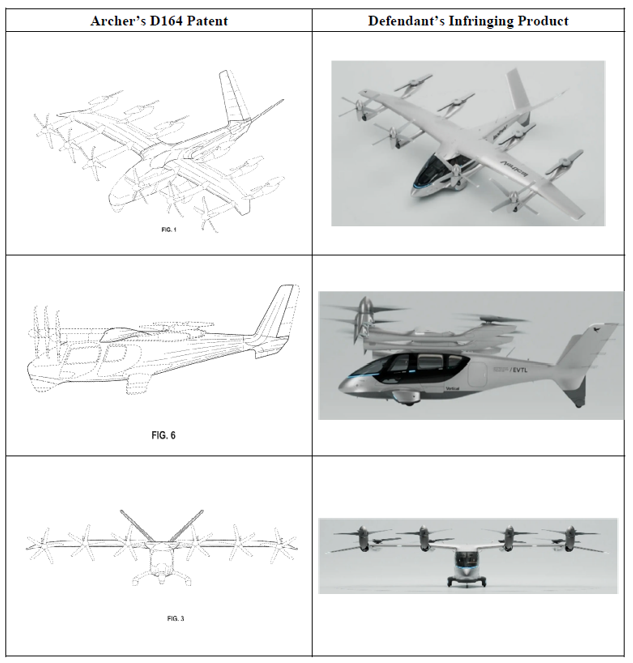
Archer alleges that the Valo aircraft copies the design of the Midnight aircraft and practices technologies covered by the asserted utility patents. Archer contends that Vertical Aerospace’s promotion and display of Valo in the U.S. constitute infringing activities.
On October 6, 2026, Vertical Aerospace filed its answer to the amended complaint, denying infringement and raising defenses, including that the Asserted Archer Patents are invalid. Vertical Aerospace also asserted counterclaims against Archer, including a claim that Archer’s Midnight aircraft infringes U.S. Patent No. 12,747,027, titled “Propulsion System Thermal Management with Propulsor Fluid Flow and Ram Fluid Flow.” Vertical Aerospace also asks the court to declare that Vertical Aerospace does not infringe the Asserted Archer Patents and that the Asserted Archer Patents are invalid.
This dispute may become an important early test of intellectual property rights in the eVTOL space. The combination of asserted design patents and utility patents targeting flight-control, propulsion, and power-distribution technologies makes this case particularly interesting. By asserting design patents, Archer gains access to additional remedies and tests that differ from those for utility patents. For example, under 35 U.S.C. § 289, a design patent owner may recover the infringer’s total profit on sales of the entire article of manufacture to which the design is applied. Furthermore, infringement of a design patent is judged by whether an “ordinary observer” would find the two designs substantially the same.
Overall, the outcome could inform how aggressively eVTOL companies may seek to protect aircraft aesthetics and underlying engineering innovations as the industry moves toward commercialization. The outcome may also provide guidance on the scope of design patent protection for aircraft configurations.





 Subscribe for News and Updates