Key Takeaways: Patent disputes involving imported products can become broader strategic contests across multiple forums. Patent owners can strengthen their position as the dispute progresses, defendants can use prosecution bars to limit that advantage, and both parties should develop appellate strategies to preserve favorable rulings in later proceedings.
Introduction
Legal disputes in the solar energy industry, which historically focused on imports of photovoltaic panels, now extend beyond the panels themselves to the components that connect the panels to the grid. An ongoing dispute between Shoals Technologies Group LLC and Voltage LLC exemplifies this shift in focus and illustrates how a patent dispute involving imported products can play out on multiple fronts, as the parties pursue opposing objectives before federal courts, the U.S. International Trade Commission (ITC), and the U.S. Patent and Trademark Office (PTO).
Parties
Shoals Technologies Group, LLC is a Tennessee company that designs and manufactures electrical balance-of-system (e-BOS) solutions for utility-scale solar, battery storage, and data center power systems. Shoals owns a family of patents covering lead assemblies that provide a way to couple the output of solar panels to a common feeder cable without requiring conventional junction boxes upstream of the inverter. The first patent in the family, U.S. Patent No. 10,992,254 (“the ’254 patent”) issued on April 27, 2021.
Voltage LLC is a North Carolina company that supplies e-BOS equipment, provides engineering services for utility-scale solar energy projects, and sells a LYNX trunk bus product that is manufactured in China.
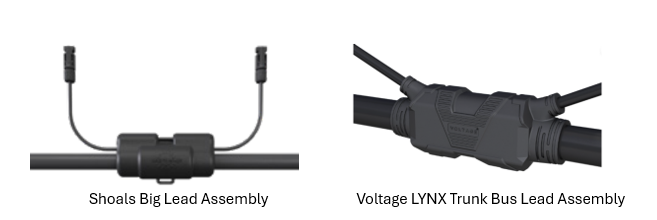
The figures below show the type of Shoals and Voltage products at issue. The figures show products with a configuration that couples two cables to a common feeder cable. The companies offer multiple other configurations for coupling various numbers and gauges of cables.
Round 1: Shoals Asserts the ’254 and ’153 Patents
Shoals Sues Voltage in Federal Court and in the ITC
On May 4, 2023, Shoals filed complaints in the ITC and in federal district court.[1] In its complaints, Shoals alleged that Voltage’s LYNX trunk bus and alternative LYNX designs infringed the ’254 patent.[2] In June, U.S. Patent No. 11,689,153 (“the ’153 patent”)—the first continuation or “child” patent of the ’254— issued, and Shoals added allegations of infringement of the ’153 patent to its complaints.
On June 9, 2023, the ITC instituted an investigation based on Shoals’ complaint. The investigation considered Voltage’s LYNX product and several alternative designs for the LYNX product. In response to Voltage’s request, the federal district court put the infringement suit on hold pending the outcome of the ITC investigation (including any appeals).
Portfolio Expansion and Attack in the Patent Office
On June 26, 2023, just weeks after the ITC investigation commenced, Shoals applied for another child patent in the ’254 family. Shoals applied for an additional child patent a few months later. On June 18, 2024, these two child applications matured into U.S. Patent Nos. 12,015,375 (“the ’375 patent”) and 12,015,376 (“the ’376 patent”).[3]
In spring of 2024, Voltage challenged the validity of the ’153 and ’254 patents by petitioning for post-grant review of the ’153 patent and for inter partes review of the ’254 patent.[4] The PTO denied the petitions.
Voltage Prevails in the ITC
On February 4, 2025, the ITC found that Voltage’s LYNX product did not infringe the ’153 patent.[5] Although the Administrative Law Judge (ALJ) had concluded that the LYNX product infringed the ’153 patent, Voltage successfully petitioned for review of the ALJ’s decision, and the ITC reversed the ALJ’s claim construction and finding of infringement.
Shoals appealed to the Federal Circuit.[6]
Round 2: Shoals Asserts the ’375 and ’376 Patents
Shoals Sues Voltage in Federal Court and in the ITC
On January 9, 2025, Shoals filed new complaints in the ITC and in federal district court.[7] Shoals now alleged that Voltage’s LYNX trunk bus and alternative LYNX designs infringed the ’375 and ’376 patents.
On February 18, 2025, the ITC instituted an investigation based on Shoals’ new complaint. This time, Voltage did not request a stay of the district court action.
Portfolio Expansion and Attack in the Patent Office
In March of 2025, Shoals applied for two new child patents in the ’254 family. The two applications matured into U.S. Patent Nos. 12,407,295 (“the ’295 patent”) and 12,519,421 (“the ’421 patent”). Shoals then added allegations of infringement of the ’295 patent to the district court infringement suit involving the ’375 and ’376 patents.
In autumn of 2025, Voltage petitioned for inter partes review of the ’375 and ’376 patents.[8] The PTO denied the petitions.
Shoals Prevails in the ITC
On May 1, 2026, the ITC found that Voltage engaged in unfair trade practices by importing LYNX products that infringed the ’375 and ’376 patents. The ITC issued a limited exclusion order against Voltage that barred the importation of infringing photovoltaic trunk bus cable assemblies for connecting solar panel arrays to an inverter. The exclusion order does not cover Voltage’s non-infringing P-Weld, D-Weld, and Bolt alternative designs.
Voltage appealed to the Federal Circuit. [9]
Shoals Prevails in Federal District Court
In August of 2026, the district court held a ten-day jury trial on the questions of liability and damages for infringement of the ’375 and ’376 patents.[10] The jury found that Voltage willfully infringed the patents. The jury awarded Shoals $96,382,050 in lost profits, calculated as the sum of $70,330,201 for lost sales and $26,051,849 for price erosion. The court issued a preliminary injunction precluding Voltage from selling its accused LYNX product.
The parties’ post-trial motions are pending.
Round 1 Resumes: Next Phase for the ’254 and ’153 Patents
On September 3, 2026, Shoals moved the Federal Circuit to dismiss its appeal of the ITC’s decision as to the ’153 patent. The parties had briefed the appeal, and the Federal Circuit had set oral argument for October 5. Voltage opposed the dismissal, arguing that Shoals planned to relitigate the issue of claim construction in the companion federal court case that had been on hold since June of 2023.
On October 22, 2026, the Federal Circuit granted Shoals’ motion to dismiss the appeal. The ITC outcome is now final, so the federal court case is about to resume.
Current Status
The dispute between Shoals and Voltage has been progressing for years, through the ITC, federal courts, and PTO. Voltage’s appeal of the ITC’s exclusion order is pending, as are the parties’ post-trial motions in the district court case for the ’375 and ’376 patents. Shoals’ claims of infringement of the ’254, ’153, and ’279 patents await adjudication in federal court, and the parties will have the opportunity to appeal federal court judgments to the Federal Circuit.
Conclusion
The litigation between Shoals and Voltage offers practical lessons for parties navigating patent disputes across multiple forums. For patent owners, where competition justifies the cost, continued prosecution of the family of patents at issue can be part of the litigation strategy, providing opportunities to pursue claims that more closely cover a competitor’s products or to draft around claim language that has created difficulties in litigation. For defendants, a protective order that includes an express prosecution bar is important from the outset of litigation. Delay in seeking the prosecution bar risks the possibility that the plaintiff’s attorneys may unintentionally or intentionally use confidential information disclosed during litigation to accelerate the prosecution of new patents or tailor new claims to cover the defendant’s current or future technology.
Both parties should consider the effect a ruling will have beyond the forum that issued it: an ITC decision does not bind the district court but may persuade it, while a Federal Circuit ruling will bind the district court. Thus, a party who obtains a favorable ruling in the ITC should consider how to preserve that victory on appeal.
[1] Photovoltaic Connectors & Components Thereof, Inv. No. 337-TA-1365 (I.T.C. May 4, 2023); Shoals Techs. Grp., LLC v. Voltage, LLC, No. 1:23-cv-00365 (M.D.N.C. May 4, 2023).
[2] In the ITC complaint, Shoals also alleged that a third party, Hikam America, Inc., infringed U.S. Patent No. 10,553,739 (“the ’739 patent”). Shoals separately sued Hikam for patent infringement in federal district court. See Shoals Techs. Grp., LLC v. Hikam America, Inc., No. 23-00811 (S.D. Cal. May 4, 2023). The ’739 patent covers connector assemblies with integrated fuses and is not in the ’254 patent family.
[3] Shoals’ litigation counsel alerted patent prosecution counsel to developments in the ITC case, and patent prosecution counsel considered public documents from the ITC proceeding, including a claim construction order, when amending claims and preparing responses to the patent office. The district court found that this communication violated a prosecution bar and accelerated the prosecution of the ’375 and ’376 patents. Shoals Techs. Grp., LLC v. Voltage, LLC, No. 1:25-cv-00026 (M.D.N.C. June 5, 2026).
[4] Voltage, LLC v. Shoals Techs. Grp., LLC, PGR2024-00022 (P.T.A.B. Mar. 27, 2024); Voltage, LLC v. Shoals Techs. Grp., LLC, IPR2024-00876 (P.T.A.B. May 7, 2024). Voltage also challenged the validity of the ’739 patent. Voltage, LLC v. Shoals Techs. Grp., LLC, IPR2024-00877 (P.T.A.B. May 7, 2024).
[5] Shoals withdrew its complaint as to the ’254 patent before the ITC reached its decision.
[6] Shoals Techs. Grp., LLC v. ITC, No. 25-1439 (Fed. Cir. Feb. 13, 2025).
[7] Certain Photovoltaic Trunk Bus Cable Assemblies & Components Thereof, Inv. No. 337-TA-11438 (I.T.C. Jan. 9, 2025); Shoals Techs. Grp., LLC v. Voltage, LLC, No. 1:25-cv-00026 (M.D.N.C. Jan. 9, 2025).
[8] Voltage, LLC v. Shoals Techs. Grp., LLC, IPR2025-01443 (P.T.A.B. Aug. 19, 2025); Voltage, LLC v. Shoals Techs. Grp., LLC, IPR2026-00068 (P.T.A.B. Oct. 16, 2025).
[9] Voltage, LLC v. ITC, No. 27-1090 (Fed. Cir. Oct. 29, 2026). The appeal is in the briefing phase.
[10] Before the trial, the district court reserved the allegations concerning the ’295 patent for a separate trial.


 Subscribe for News and Updates