Key Takeaway: Energy companies that market their technologies as environmentally friendly should ensure the claims are accurate and consistent with regulatory guidance.
Innovation in the energy industry is often driven by concerns about climate change, sustainability, or efficiency. Accordingly, energy companies may choose to promote their technologies or brands by highlighting environmental benefits, like reduced carbon emissions and sustainability, or by publicizing support for renewable energy research or conservation efforts. But companies that make exaggerated or misleading claims of environmental benefits can expose themselves to liability for false advertising or unfair trade practices and to claims of “greenwashing,” the practice of creating a misleading image of positive environmental contributions to disguise harmful impacts. State enforcement actions, competitor lawsuits, and guidance from the Federal Trade Commission highlight the importance of ensuring that environmental marketing does not mislead consumers.
State Greenwashing Suits
Several high-profile greenwashing suits are currently pending in state courts. In these suits, states including Minnesota, Connecticut, and California claim that Exxon Mobil, other oil and gas companies, and industry groups violated state laws that prohibit false advertising and unfair trade practices. Notably, California also claims that the companies violated a California law that specifically prohibits misleading environmental marketing.
The states allege that the companies engaged in a campaign of deception that misled consumers about the negative effects of the companies’ business practices on the climate.[1] The states’ allegations focus on weekly advertorials—advertisements written and designed to look like news articles or editorials—that Exxon Mobil published in the New York Times for decades, beginning in the 1970s. The states also allege that Exxon Mobil continued to portray itself as a corporation committed to seriously combatting climate change even after Exxon Mobil publicly acknowledged that combustion of oil and gas contributes to climate change. The states seek civil penalties, disgorgement of profits, injunctive relief, and other remedies. The image below shows an Exxon Mobil website that appears in the states’ complaints.
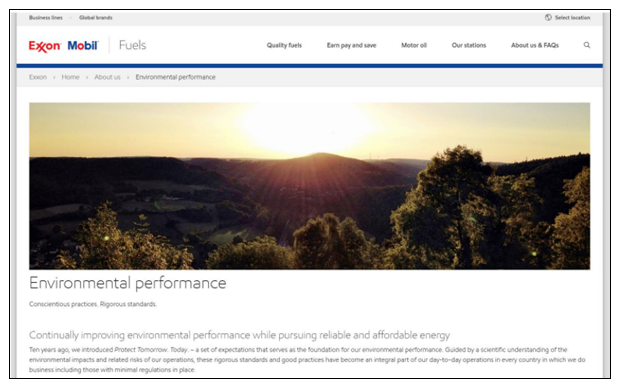
These cases have been pending for years: Minnesota and Connecticut filed suit in 2020, and California followed in 2023. The suits are part of a broader wave of climate-change litigation in which state and local governments have asserted numerous claims against oil and gas companies. The parties have been litigating issues of federal jurisdiction as the oil and gas companies have fought to remove the cases from state to federal court,[2] and as the United States,[3] as well as other states,[4] have tried to prevent the cases from going forward. The California case has been on hold since October 2025, pending the Supreme Court’s decision in another climate-related case that raises the question of federal jurisdiction,[5] and the Minnesota court is considering a similar hold. The Connecticut case is moving forward.
Competitor Greenwashing Suits
Section 43(a) of the Lanham Act allows businesses to sue competitors that make false or misleading statements in commercial advertising for money damages, attorneys’ fees, and injunctive relief. The business must show that it has been or is likely to be damaged by the accused statements and that the statements matter to customers.
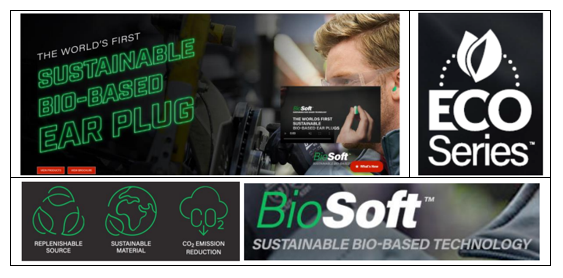
One example of a Lanham Act greenwashing claim is currently pending in the Central District of California.[6] There, Moldex-Metric sued Protective Industrial Products, Inc. (PIP) over PIP’s marketing of its BioSoft earplugs. Moldex alleges that PIP falsely advertised its earplugs as being comprised of 82% bio-based content and having a carbon footprint 5.6 times smaller than polyurethane or PVC foam earplugs. Moldex alleges that PIP’s BioSoft earplugs contain only 5–40% bio-based content and that PIP cannot substantiate its claims about carbon emissions. The images below show examples of advertising that appears in Moldex’s complaint.
Federal Regulatory Guidance
The Federal Trade Commission (FTC) publishes “Green Guides” to help marketers avoid making environmental claims that mislead consumers. The Green Guides provide (1) general principles that apply to all marketing claims, (2) explanations of how consumers are likely to interpret claims and how marketers can substantiate their claims, and (3) guidance on how marketers can qualify their claims to avoid deceiving consumers.
Marketers within the energy industry should pay close attention to the FTC’s guidance for claims about renewable energy, carbon offsets, and certificates or seals of approval. Courts evaluating claims of greenwashing or other false or misleading environmental advertising are likely to consider the FTC’s guidance.
[1] See Minnesota v. Am. Petroleum Inst., No. 62-CV-20-3837 (Minn. Dist. Ct. June 24, 2020); Connecticut v. Exxon Mobil Corp., No. HHD-CV20-6132568-S (Conn. Sup. Ct. Oct. 13, 2020); California v. Exxon Mobil Corp., No. CGC-23-609134 (Cal. Sup. Ct. Sept. 15, 2023).
[2] See, e.g., Minnesota v. Am. Petroleum Inst., 63 F.4th 703, 708 (8th Cir. 2023) (affirming the district court’s decision to remand the case to state court); Connecticut v. Exxon Mobil Corp., 83 F.4th 122, 129 (2d Cir. 2023) (same).
[3] See United States v. Minnesota, No. 26-cv-02456-SRN-DLM (D. Minn. May 4, 2026) (seeking an injunction to prevent the Minnesota suit from progressing).
[4] See Alabama v. California, 145 S. Ct. 757 (2025) (denying Alabama’s motion for leave to file a bill of complaint).
[5] See Suncor Energy (U.S.A.) Inc. v. Cnty. Comm’rs of Boulder Cnty., 146 S. Ct. 1605 (2026) (granting writ of certiorari).
[6] See Moldex-Metric, Inc. v. Protective Indus. Prods., Inc., No. 25-cv-08931-FMO-E (C.D. Cal. Sept. 18, 2025).





 Subscribe for News and Updates