Key Takeaways: With demand for high-efficiency power devices continuing to grow, companies are placing greater emphasis on maintaining their competitive advantage by protecting their intellectual property. Companies commercializing gallium nitride (GaN) and silicon carbide (SiC) technologies should regularly evaluate their intellectual property positions and potential infringement exposure.
On July 7, 2026 Wolfspeed, Inc. filed a patent infringement lawsuit against Navitas Semiconductor Corporation in the U.S. District Court for the District of Delaware. The lawsuit alleges that Navitas’s products, including its GaNFast®, GaNSlim™, and GaNSafe® GaN product families, along with GeneSiC™ MOSFETs and SiCPAK® modules infringe U.S. Patent Nos. 8,169,005, 10,998,418, 10,886,396, 10,749,443, and 11,888,392 directed to gallium nitride (GaN) and silicon carbide (SiC) semiconductor technologies.
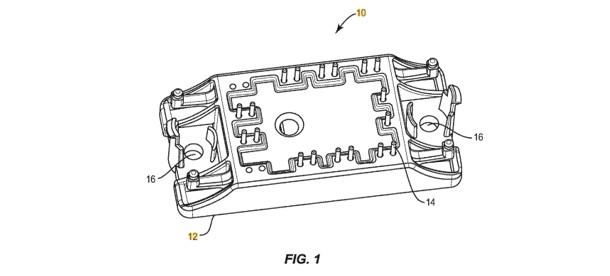
U.S. Patent No. 11,888,392 FIG. 1 displaying an isometric view of a power converter module according to one embodiment of the present disclosure.
Source: Google Patents
According to Wolfspeed, these patents cover foundational innovations relating to the design and manufacture of wide-bandgap semiconductor devices. These technologies are used in applications requiring highly efficient power conversion, including electric vehicles, data centers, and renewable energy systems.
Wolfspeed CEO, Robert Feurle, stated, “Protecting our patent portfolio is a strategic priority for the company and our shareholders. This action reflects our commitment to enforcing our rights and protecting continued investment in next-generation SiC and GaN technologies.”
For companies operating in the energy and power electronics sectors, the dispute serves as a reminder of the increasing value of intellectual property rights in the transition toward higher-efficiency semiconductor technologies. As demand for advanced power devices continues to accelerate, ownership of core GaN and SiC technologies has, as demonstrated by this lawsuit filing, proved to be a significant competitive advantage.
Navitas responded publicly one day after the filing, stating that it considers the allegations meritless and intends to vigorously defend its products and technology. The company also highlighted its own intellectual property portfolio, which reportedly contains more than 300 patents, and emphasized its history of independent innovation. As is common in patent disputes, Navitas’s response suggests that the case may ultimately involve challenges to infringement allegations, patent validity, or both.
Although the litigation remains in its early stages, the case bears watching for companies involved in energy storage, electric transportation, charging infrastructure, and other industries that rely on advanced power semiconductors. Whether the matter proceeds through claim construction and trial or ultimately resolves through settlement or licensing discussions, this dispute highlights a broader trend. That is, as GaN and SiC technologies become increasingly central to modern energy systems, semiconductor companies are capitalizing on their patent rights to protect technology investments and maintain competitive positioning in one of the fastest-growing segments of the energy technology market.





 Subscribe for News and Updates