Key Takeaway: The Trademark Trial and Appeal Board (“TTAB”) is currently reviewing a case centered on video rental company Blockbuster, which has the potential to significantly widen the scope of trademark dilution protection by allowing companies to point to past success as evidence of current fame. A final decision by the TTAB in this case will undoubtedly influence future trademark filing and enforcement strategies.
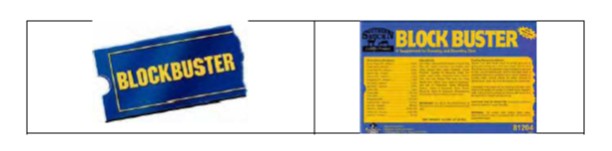
Blockbuster L.L.C., the once widespread video rental company, has filed an opposition against an application for BLOCK BUSTER filed by Southern Seed and Feed LLC (“Southern”), covering various animal feed products. Blockbuster alleges that Southern’s use of the mark, which on the product label is yellow on a blue background and above a ripped movie ticket design listing directions for use, is confusingly similar to Blockbuster’s registered BLOCKBUSTER and ripped ticket logo mark. See below reproduced from Blockbuster’s Notice of Opposition, which can be found here: https://ttabvue.uspto.gov/ttabvue/v?pno=91304514&pty=OPP&eno=1. More interesting, however, is Blockbuster’s claim that Southern’s mark and application “dilute” Blockbuster’s famous trademarks.
Dilution law is a subset of trademark law that protects against more than the standard likelihood of confusion. Dilution law also protects a mark against having its distinctiveness impaired – in other words, it protects a mark holder against consumers associating the mark with more than one source, regardless of whether confusion exists. Because this is an extremely broad protection, it only applies to marks that are proven “famous” at the time the junior mark is adopted or when the junior federal application is filed. Fame for dilution requires evidence of widespread consumer recognition. The bar for fame is so high that owners of marks like the Texas Longhorns logo and the red wax seal on Maker’s Mark whiskey bottles have failed to submit sufficient evidence to prove fame for dilution. Makers Mark Dist Inc v. Diageo North America, No. 3:2003cv00093 – Document 296 (W.D. Ky. 2010); The Board Of Regents, The University Of Texas System v. KST Electric, LTD.; W.D.Tex.; A-06-CA-950 LY.
At its peak, Blockbuster had thousands of stores across the US and brought in billions in revenue, with reportedly over 43 million households having Blockbuster memberships. The franchise became so successful that at one point there were even plans to open a Blockbuster theme park in South Florida. In its heyday, Blockbuster may well have had significant evidence to support the fame of the BLOCKBUSTER mark.
However, that heyday is well in the past. Blockbuster closed all its corporate-owned stores in 2014, leaving only fifty franchised locations globally. Since 2019, all but one of those franchised locations have closed, and as of 2022 that location only employs twelve people. The fall of Blockbuster has been well-chronicled, but it now presents the USPTO with an interesting question. Can a once major brand that has been reduced to almost non-existence still claim that its trademark is famous enough to qualify for dilution protection based on its past success?
The resolution of that question is of great importance to a number of companies. Many once thriving businesses, some of which were essentially household names, have been reduced to a shadow of their former prominence but nonetheless remain active. For example, Sears still operates five stores in the US, and K-Mart still operates three stores in the US and its territories. If Blockbuster can successfully allege fame based on past use and recognition, this could open the door for nearly extinct brands to assert far greater trademark rights than was previously assumed. Thus, both new applicants and diminished brands should be watching this case with great interest, as any decision from the USPTO will undoubtedly inform future trademark application and enforcement strategies.





 Subscribe for News and Updates