Key Takeaways: Private investment in space technology continues an upward trend in 2026, with increasing growth in late stage and venture growth deals, including private equity purchases. Against a backdrop of the “dual use” (private/public) nature of space technology and increased IP activity in this area, a U.S. Senate Bill proposes to alter the balance of certain IP rights between private companies and the contracting government agencies, including requirements for contractors to justify certain restrictions on data rights.
Space technology investment continues to grow in 2026, with private equity and late-stage interest growing. Given the private and public applicability of many space technologies, and increased patent filing activity in this area, a U.S. Senate proposal affecting IP rights in contracts may become more relevant to the aerospace industry.
Space Technology Investment in 2026
In 2025, global investment in space technology was about $12.4 billion, a 48% increase over 2024. Compare that to just Q1 of 2026, where private capital in space saw $9.4 billion in closed deals. Further, the Space Economy Institute has reported “April 2026 has shattered previous records for private capital in space. Venture, corporate, and institutional investors deployed $28.7 billion across 420 deals — a 95% CAGR since 2023 — creating 18 new space unicorns and pushing total private sector valuation above $1.1 trillion.”
There have been reportedly about $14.7 billion in private equity deals globally so far in 2026 in aerospace and defense. That is about twice the amount from 2024, and about 90% of the total deal value for all of 2025.
Industry sectors targeted by investors include satellite constellations and broadband (about a third of the total funding), in-space manufacturing at about $5 billion, lunar mission technology at about $4 billion, and space mining and tourism each attracting about $3 billion.
Private Equity and Late Stage Investment
Private equity and late stage investors have made significant investments and acquisitions in space technology in 2026. One report describes a possible “new phase for a sector long defined by VC money.” That was in response to Swedish company EQT’s buyout of a Berlin-based satellite deployment company Exolaunch. Further, in March 2026 U.S.-based space technology platform developer Arka was acquired by CACI for $2.6 billion from funds managed by Blackstone.
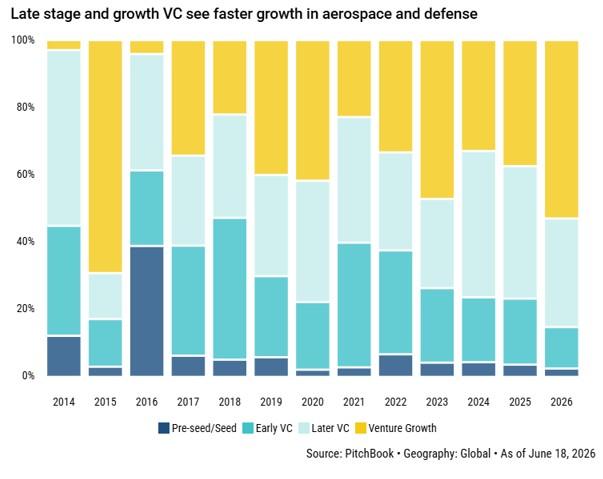
The venture capital investments are increasingly in later stage and growth deals. As PitchBook reports, “Across all space-related VC investments, around 85% of deal value now sits in late-stage and venture growth deals—the two segments seeing the fastest annual growth in terms of total deal value.” They show a diminishing percentage of pre-seed/seed and early VC deals for aerospace and defense in 2026, with a growing ratio of late stage and venture growth deals, as compared to recent years past:
Senate Proposal Affecting IP in Government Aerospace Contracts
This healthy appetite for space technology is coupled with growing IP activity and government proposals affecting IP rights.
The patent system has long been correlated with the growth of U.S. innovation generally. We see this patent growth in space technology as well. The United States Patent and Trademark Office reports the “number of patent applications disclosing space inventions grew by 144% between 2003 and 2023, which is about four times larger than the growth rate for all patent applications.”
Further, many space technologies have “dual use” capability, i.e. private (e.g. civilian) and government (e.g. military) applications. The U.S. government thus routinely contracts and/or co-develops such technologies with private companies.
As the space technology industry grows and related IP activity increases, the U.S. government is proposing changes to government contracting that would affect certain IP terms. A Senate proposal applies to contracts generally, including aerospace contracts. There is also a companion House Resolution.
In June 2026, the Senate introduced a Defense Reauthorization Bill for fiscal year 2027 that could alter the balance of IP rights between private and public actors. For example, the Bill’s Executive Summary states it “Shifts burden of proof to contractors to justify restrictions on technical data.”
The particular Senate proposal would add language to 10 U.S.C. § 3771(b) with a default of government purpose rights in certain technical and software data. Anything less, in certain circumstances, requires that “the contractor establishes, through clear and convincing evidence, entitlement to more restrictive rights.” Requirements include, among other things, “factual documentation of private development funding.” Contractors will need to consider whether they can satisfy all of the requirements should they desire to provide less than government purpose rights.
Additional proposals in the Senate Bill affecting IP rights include the following:
- Copyright: Amendments to grant the government copyright ownership over material produced by the Defense Security Cooperation University. This would be an additional exception added to the general rule that U.S. government works are not subject to copyright. (See proposed amendment to 17 U.S.C. § 105(d)(2).)
- Intellectual Property Dispute Resolution: The Senate bill is expected to eventually include a provision to create or expand the role of a DoD IP Ombudsman and establish a voluntary expert mediation mechanism for resolving IP disputes between the government and contractors. The provision would be similar to that of the companion House Resolution. (See proposed amendment to H.R. 8800, Sec. 862.)
- Reverse Engineering and Right-to-Repair: Various provisions of the Senate Bill would allow the military to maintain and repair its own equipment in certain urgent conditions. This may override certain contractual IP restrictions, such as proprietary technical data, repair manuals, software, and manufacturing processes.
As the private space technology industry grows, innovators and investors should be aware of the shifting landscape with respect to government contracting. “Dual use” technologies may provide an additional revenue stream by selling to the government, and it will be important to consider how such business strategies may affect your IP rights.





 Subscribe for News and Updates