Today, Aaron Judge (“Judge”) is a household name for sports fans across the United States. However, in 2017, Judge was just entering the Major League Baseball scene and carving out a name for himself—he won Rookie of the Year and was the first rookie to ever win the Home Run Derby. The day Judge won the 2017 Home Run Derby, allegedly unrelated to Judge’s rookie year success, a New York individual named Michael Chisena just happened to call his attorney to determine whether “ALL RISE” and “HERE COMES THE JUDGE” were trademarks he could register for clothing. Seeing his chance to hit a grand slam, Chisena filed applications for ALL RISE, HERE COMES THE JUDGE, and the design mark 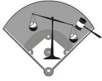 for clothing in Class 25. The Examining Attorney assigned to the applications was not a baseball fan or attuned to Judge’s recent accolades, as all three applications were quickly approved for publication upon initial examination. In fairness to the Examining Attorney, Judge may not have been a household name at that time where the USPTO would have issued a refusal under Section 2(a) on the ground that the marks create a false association with a living person.
Fortunately, Judge got wind of the filings and opposed Chisena’s applications with the help of the Major League Baseball Players Association. Judge relied on his unregistered common law rights in connection with the same word marks and allegedly similar design marks (e.g., gavels, image of courthouse, scales of justice). The Trademark Trial and Appeal Board (“TTAB”) decision found that Judge’s common law marks were distinctive, functioned as trademarks, and were used as trademarks before Chisena’s constructive priority date (i.e., the filing date for each of his applications). The TTAB also found a likelihood of confusion existed between Chisena’s proposed marks and Judge’s marks. Believing that the TTAB made an error in its ruling, Chisena appealed the TTAB’s decision to the Federal Circuit seeking the legal equivalent of MLB’s “Instant Replay Review.”
Applicants who are dissatisfied with the TTAB’s decision have two avenues to appeal. First, they can appeal directly to the Federal Circuit, the TTAB’s primary reviewing court. Alternatively, applicants can appeal to a district court. This second avenue is generally used when applicants want to supplement the record before the TTAB. Here Chisena chose to appeal to the Federal Circuit, which reviewed the TTAB’s priority decision (a question of fact) for substantial evidence.
The Federal Circuit affirmed the TTAB’s decision that Chisena struck out at the USPTO (see Chisena v. Major League Baseball Players Ass’n, Appeal No. 2023-2073 (Fed. Cir. Jan. 8, 2026)). The Federal Circuit first acknowledged that to establish priority, one must show proprietary rights in the mark that produce a likelihood of confusion, which can be a prior registration, prior trademark or service mark use, prior use as a trade name, prior use analogous to trademark/service mark use “or any other use sufficient to establish proprietary rights.”
The Federal Circuit found that based on the evidence of record, the TTAB’s priority determination was supported by substantial evidence. The Federal Circuit relied on testimony that Chisena “did not use the marks in commerce until after” the filing date of his applications, and therefore Chisena could rely only on the his constructive first use dates. The Federal Circuit then analyzed testimony and documentation concerning multiple officially licensed products sold by the MLBPA (a licensee of the common law rights associated with Judge’s trademarks). Importantly, these licensed uses were sold prior to Chisena’s constructive first use dates, and the Federal Circuit held that the list of products sold—in addition to the specific dates provided for each first use date of the licensed products—confirmed that the TTAB’s determination that Judge had rights in the marks predating Chisena’s rights was reasonable.
Takeaways
The decision underscores a well-established principle in trademark law—that priority of use may be established through the valid licensing of common law trademark rights. The case also serves as a good reminder regarding the importance of properly documenting the use of your trademarks in commerce (regardless of whether one has an active trademark application for it) and watching for published marks.





 Subscribe for News and Updates