Key Takeaway: Medical device companies should prepare a cohesive patent and premarket submission strategy by considering FDA recommendations when developing AI-enabled features and coordinating statements made to the Patent Office and the FDA.
The U.S. Food & Drug Administration (FDA) is increasingly focused on artificial intelligence (AI)-enabled medical devices. The FDA’s evolving AI expectations for these devices can affect competitive advantage, valuation, commercialization, acquisition diligence, and IP strategy.
On August 18, 2026, the FDA released a discussion paper seeking feedback on the regulation of generative AI-enabled medical devices. The paper addresses risk assessment, premarket evaluation, postmarket monitoring, and related regulatory topics. The paper also identifies a possible two-axis framework for autonomous generative AI-enabled devices based on the severity of harm and degree of independence. Reportedly, its most novel concept is the FDA’s consideration of a competency-based approach to premarket evaluation.
On September 25, 2026, the FDA released draft guidance on premarket submissions for Robotically-Assisted Surgical Devices (RASDs), including AI-enabled device software functions. For example, the draft provides the following recommendations:
You should perform a robust risk assessment of any additional RASD features specific to your system …. A comprehensive performance testing plan should be developed based on the level of risk associated with each feature.… If your RASD is intended to be used concurrently with high energy imaging modalities or incorporates AI/ML-enabled features, we recommend that you discuss your approach with FDA through the Q-submission program.
The draft cites earlier FDA publications including Artificial Intelligence-Enabled Device Software Functions: Lifecycle Management and Marketing Submission Recommendations and Marketing Submission Recommendations for a Predetermined Change Control Plan for Artificial Intelligence-Enabled Device Software Functions.
AI-enabled features will likely become more prevalent in medical devices. The figure below shows the number of U.S. patent and patent-application publications containing both G06 and A61 Cooperative Patent Classification (CPC) designations over time, as an indicator of activity at the intersection of computing and medical technology. Because the CPC classifications are broader than AI-enabled medical devices, the data should be viewed as a proxy rather than a precise count of such devices.
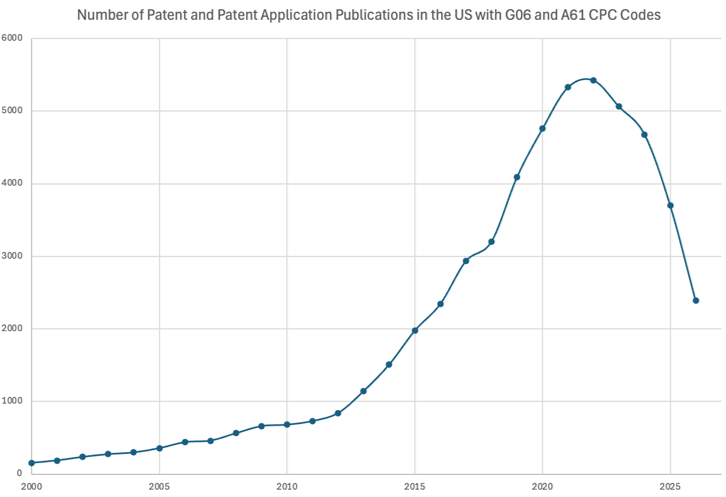
Based on data from Espacenet accessed on September 29, 2026
As AI becomes embedded in medical devices, companies should manage regulatory evidence, patent strategy, software governance, and product-change planning as connected workstreams. Patent prosecution may overlap with the FDA’s review of a corresponding premarket submission, requiring companies to navigate two distinct review processes simultaneously.
On one hand, patent claims generally must be novel and non-obvious. Applicants often amend the patent claims and/or argue that the patent claims are distinguishable from cited references. These amendments and arguments can show that the patent claims are novel and non-obvious over cited references.
On the other hand, a premarket notification submission must compare the device with one or more legally marketed predicate devices. The identified similarities and differences, together with supporting information, are used to demonstrate that the new device is substantially equivalent to a predicate device with respect to safety and effectiveness.
Medical device companies should develop cohesive patent and regulatory strategies for AI-enabled products. Patent counsel, regulatory personnel, and product teams should coordinate statements to the U.S. Patent and Trademark Office and the FDA concerning a device’s technical features, similarities, differences, and performance. Although the applicable legal standards differ, coordination can reduce the risk of inaccurate or unexplained inconsistencies undermining patentability or enforceability of a corresponding patent or complicate FDA clearance. The discussion paper can be found here and is available for comments until October 19, 2026. The draft guidance can be found here and is available for comments until November 24, 2026.




 Subscribe for News and Updates